
CNI News
8 July 2026
Political and economic analysts are closely monitoring just how critical Laos is becoming to Myanmar's electricity generation and consumption sector.
At the invitation of Lao President Mr. Thongloun Sisoulith, Myanmar President U Min Aung Hlaing visited Laos from July 3 to 5, 2026, where he held talks with the Lao President, Prime Minister, and President of the National Assembly.
During the visit, the governments of both countries signed an agreement to implement a hydropower project along the Mekong River basin capable of generating 2,790 megawatts of electricity.
Looking at Myanmar's power sector alone, Laos stands out as a strategically vital country, economic and banking expert U Htay Aung Kyi told CNI News.
"As far as I know, having lived in that region before, the section where the Mekong River borders Laos and Myanmar is between 145 and 150 miles long. The conditions are suitable for building a hydropower plant. A border connection stretching over 100 miles is quite extensive and sufficient for constructing a major hydropower project. My main consideration is that this river originates in Yunnan and Tibet, and flows through Laos, Thailand, Cambodia, and Vietnam. So, there is the question of what the downstream countries will say. Electricity is strategically vital. Laos is a country highly successful in power generation—they export electricity all the way to the Malaysian and Singaporean borders. When it comes to experience in this field, I believe Laos has even more than we do; it is a country that makes a living selling electricity," U Htay Aung Kyi said.
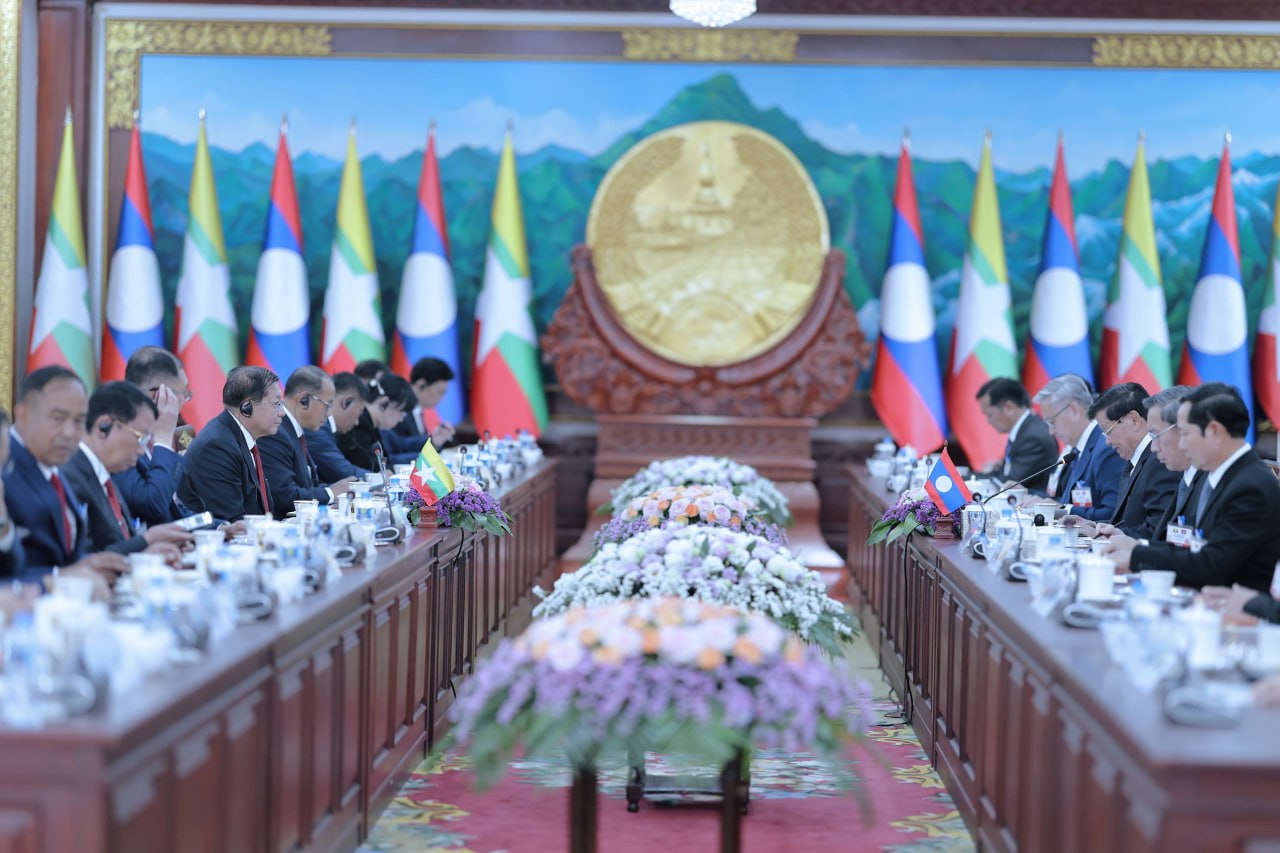
Lao President Thongloun Sisoulith and Myanmar President U Min Aung Hlaing seen holding talks.
Laos already sells electricity to Thailand, Malaysia, and Singapore, so it will be highly beneficial if Myanmar can collaborate with Laos on joint power generation, U Htay Aung Kyi added.
"Laos exports electricity right to the borders of Thailand, Malaysia, and Singapore. Even Singapore has to buy power from Laos. So, electricity is crucial—without it, you cannot do anything else. If you look at it just from that angle, it is a geopolitical strategy. Our country is facing a severe power deficit. Without electricity, don't even think about other developments; nothing is possible. Electricity is highly foundational. I am glad to see this cooperation with Laos to generate electricity. However, if we are to implement it, we must take the lower Mekong basin into consideration. Since the Mekong River runs through Thailand, Cambodia, and Vietnam, we need to wait and see what comments these countries will make. If they are okay with it, then I am delighted," he said.
Economic analysts point out that Laos is harnessing its rivers to sell electricity back to neighboring countries, striving to become the powerhouse hub of Southeast Asia.
On the other hand, environmental organizations and downstream countries like Vietnam and Cambodia remain deeply concerned over the construction of dams along the Mekong River.
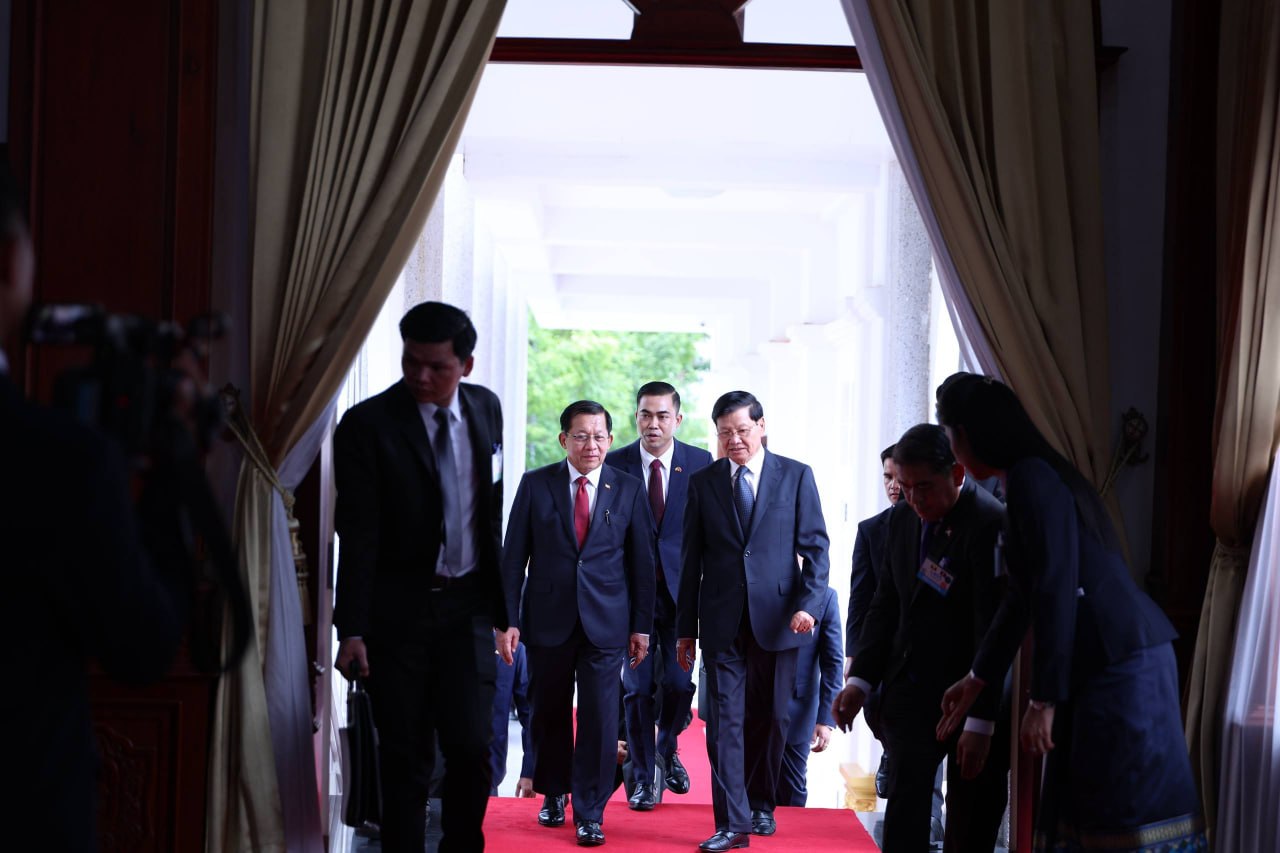
Lao President Thongloun Sisoulith seen with Myanmar President U Min Aung Hlaing.
Economic analyst U Thet Zaw told CNI News that implementing practical bilateral agreements between Laos and Myanmar is a positive move, and that Laos could become partly significant for Myanmar’s energy sector.
"Lately, Laos has boosted its economy through power generation. By exporting electricity back to China, they have generated substantial revenue. Now, Laos and Myanmar have signed an agreement to jointly generate 2,790 MW of electricity from the Mekong River, aiming to wrap things up within six months. After that, it is still unclear who will execute the final phase, but I see this as a solid economic opportunity. We cannot rely on them entirely, but it will be partly beneficial. If we can truly execute our own plans, there are about six or seven projects upstream from the Myitsone dam on the Irrawaddy River. If those can be implemented, Myanmar would have a highly self-sufficient power supply," U Thet Zaw said.
The joint project with Laos is slated for implementation along the Mekong River, where it flows along a 150-mile border stretch between Tachileik District in eastern Shan State and Luang Namtha Province in Laos.